Get in Touch with Teng Yang Company


PA hot melt adhesive film is not just another layer used for temporary binding. In many manufacturing systems, it is the core control layer for bond consistency, appearance quality, and downstream process stability. If your existing polyamide solution page is focused on product specs and order-ready usage, this guide is the operational playbook: how to choose the right film for your line, where failures happen, how to troubleshoot without stopping production, and how to optimize cost and yield over time.
This guide is designed for project and production teams in packaging, building materials, insulation, and electronics-related assembly workflows who need more than a brochure-level explanation. We compare practical scenarios, failure signatures, and decision criteria so you can determine when PA hot melt adhesive film is the right choice, and when another material class may be safer.
1) What PA Hot Melt Adhesive Film Is and How It Works
PA hot melt adhesive film is a thermoplastic adhesive film based on polyamide chemistry. In practice, it is usually loaded and activated by controlled heat, then transitions from solid to molten state during processing and solidifies to form a bond as it cools. Unlike solution-based adhesives, it does not rely on solvent evaporation or high-temperature curing chemistry in the same way.
In a typical run, the film performs three jobs:
- It delivers controlled melt flow at a predictable temperature window.
- It provides tack and wetting under pressure and heat.
- It locks geometry and interface contact after cooling.
For teams comparing with liquid or foam adhesives, PA film is often easier to meter in high-speed lines because it is pre-dosed and often easier to automate. However, this convenience depends on line consistency: temperature uniformity, dwell time, and substrate preconditioning.
2) Where PA Film Is Usually the Best Choice
PA hot melt adhesive film is best in processes that need repeatability, low mess, and stable thickness control. Typical use cases include:
- High-speed lamination: where precise bead/control of thickness improves downstream handling.
- Package seam support and multi-material assembly: especially when line speed and repeatability matter.
- Insulation and structural panel support: when thin, uniform adhesive layers are needed across large areas.
- Pre-cut or pre-form assemblies: where downstream robot handling demands consistent tack windows.
It is less suitable for processes that require extreme low-temperature application windows that the film cannot meet, or where substrate contamination is highly variable and difficult to control. In those environments, pre-treatment or alternate adhesive architectures may be needed.
3) Decision Framework: How to Choose the Right PA Film for Your Line
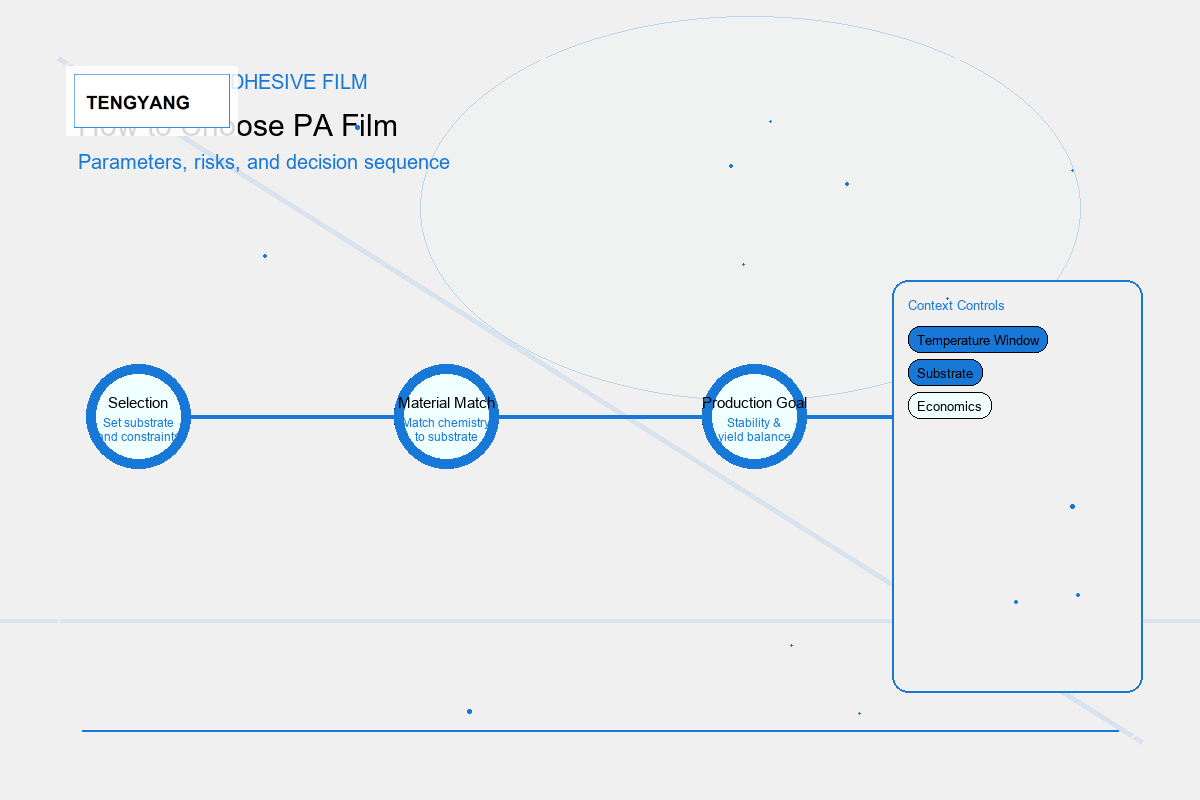
Many teams over-optimize one indicator (for example cost per kg) and then get stuck with line instability. A better approach is a five-factor selection matrix:
3.1 Substrate Pair and Surface Energy
Start from the surface profile. Low-energy substrates usually need a film with stronger initial wetting behavior and stable coating dynamics. If your substrate is already prone to contamination or has release-agent residues, pre-treatment should be treated as a separate process variable, not an afterthought.
3.2 Temperature and Dwell Window
Map your maximum safe line temperature and minimum required open time. The best film choice is one that opens, wets, and re-hardens without forcing your oven/roller profile into unsafe margins.
3.3 Mechanical Stiffness of Final Bond
Different production goals need different flexibility. Some systems require a harder, more rigid bond to resist creep; others need controlled elasticity to absorb vibration. If final performance fails in environmental cycling, this is often a film-family mismatch issue.
3.4 Processing Speed and Automation Compatibility
Evaluate line speed with real-time process limits. On high-speed lines, even a strong film grade can underperform if its melt curve is too slow to reach equilibrium at throughput speed.
3.5 Economics Over Full Cycle
Total cost should include scrap rate, rework losses, line stoppage cost, and maintenance downtime. A slightly higher film price can still lower OPEX if it stabilizes yield and reduces rejects.
If you want, you can evaluate this in a simple worksheet:
- Substrate group
- Activation temp target
- Bond strength target
- Cycle time tolerance
- Reject trend and rework loss
- Material and waste costs
4) Correct Process Parameters: The Most Common Source of “Unstable” Results
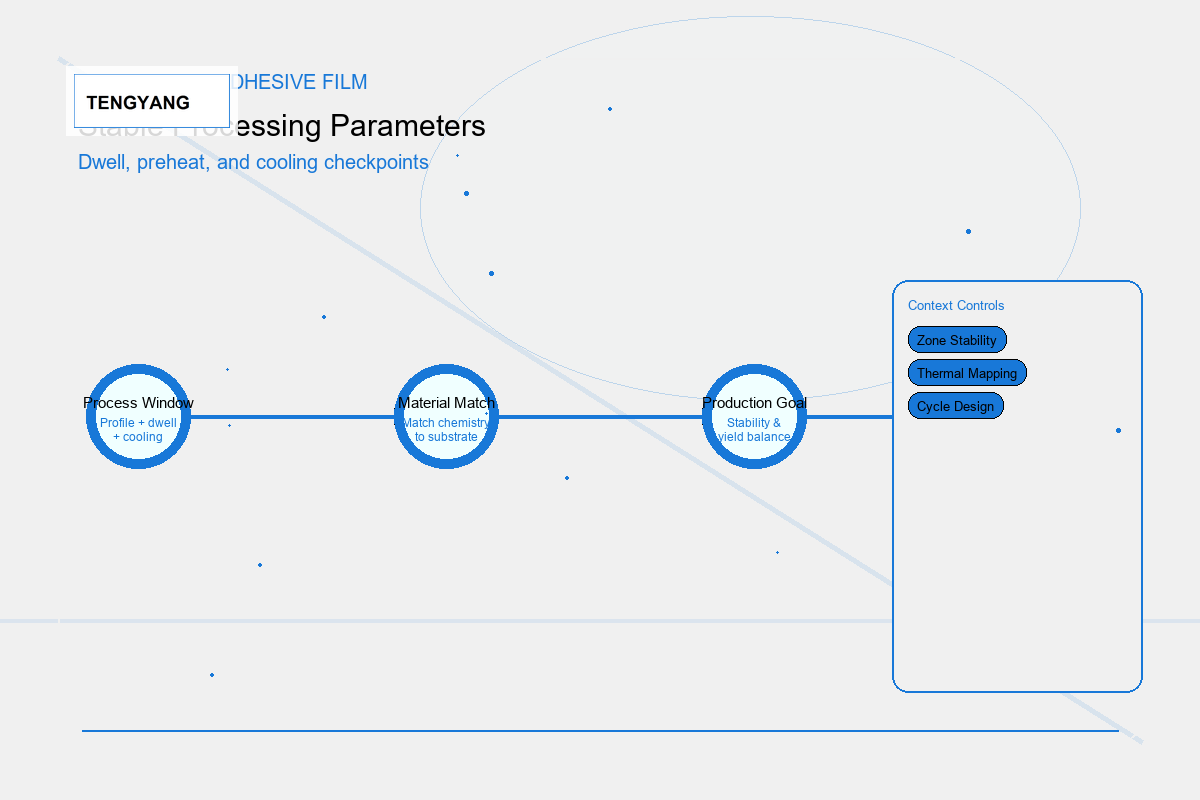
In PA hot melt adhesive film production, process control is usually where teams lose performance. Good materials still fail when processing conditions drift.
4.1 Temperature Profile
Set and document a multi-zone profile, not a single-point assumption. Typical failure mode: central zones overheat while edge zones lag, causing incomplete wetting near edges and weak seams.
4.2 Pressure and Dwell Consistency
Uneven pressure causes uneven spread and microscopic voids. If your line has uneven nip force, local bond quality will vary even when all other settings are correct.
4.3 Line Speed versus Cooling
Higher speed increases throughput, but can underdevelop interface wetting if cooling is insufficient. A balanced line often wins over peak speed when customer complaints spike after launch.
4.4 Surface Preparation and Environment
Moisture and dust reduce adhesion reliability in many plants more than people think. Add simple environmental checks: humidity trend, dust events, and pre-cleaning frequency.
5) Failure Signatures and Fast Troubleshooting Matrix
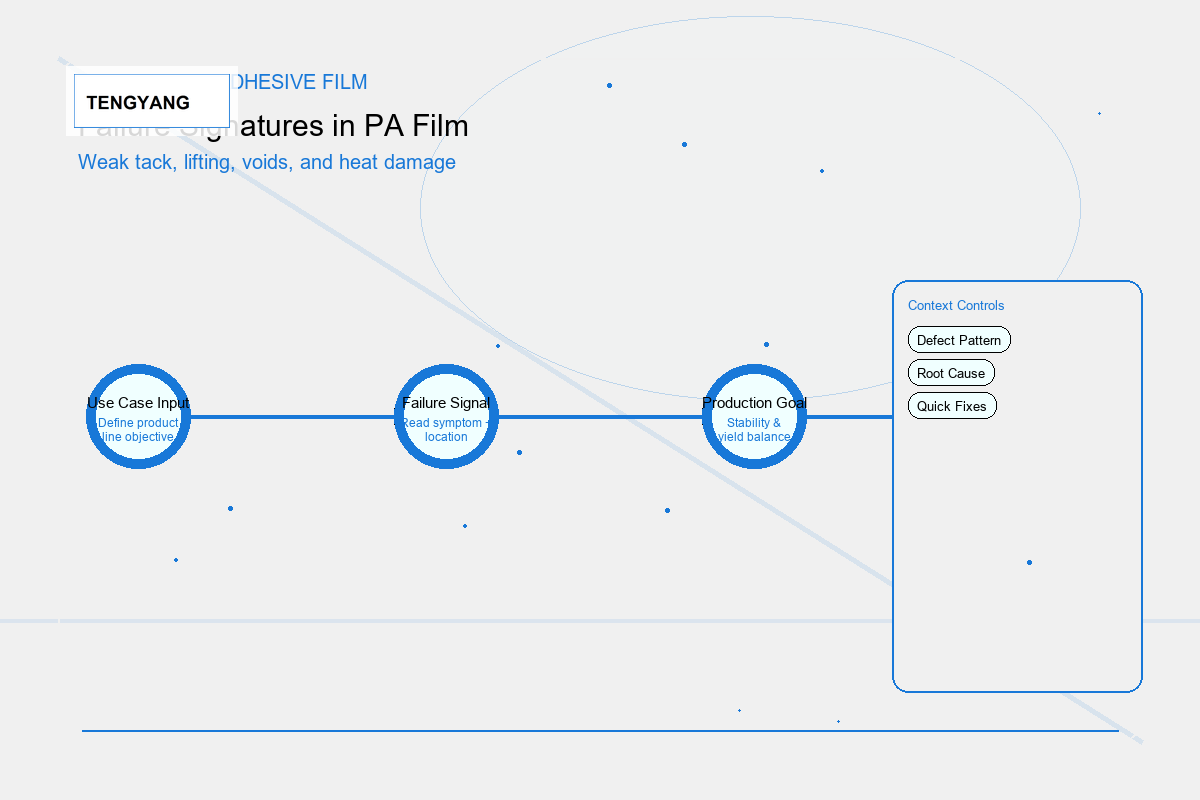
Most production calls come from the same 10 failures. Use the matrix below during line recovery to reduce trial-and-error.
- Weak initial tack: likely underheating, too short dwell, or contaminated substrate.
- Peel-off after heat aging: likely insufficient compatibility, or incorrect cooling profile.
- Bubbles / voids: substrate outgassing, trapped moisture, or pressure imbalance.
- Edge lifting: edge chilling too fast or local heat deficit.
- Yellowing / heat damage: overexposure to temperature or dwell overshoot.
Use a strict recovery order: confirm film lot, verify temperature logs, check pressure bars, review environmental data, then rerun only one parameter at a time. This avoids compounding unknowns.
6) Quality Checklist: From Incoming Material to Final Inspection
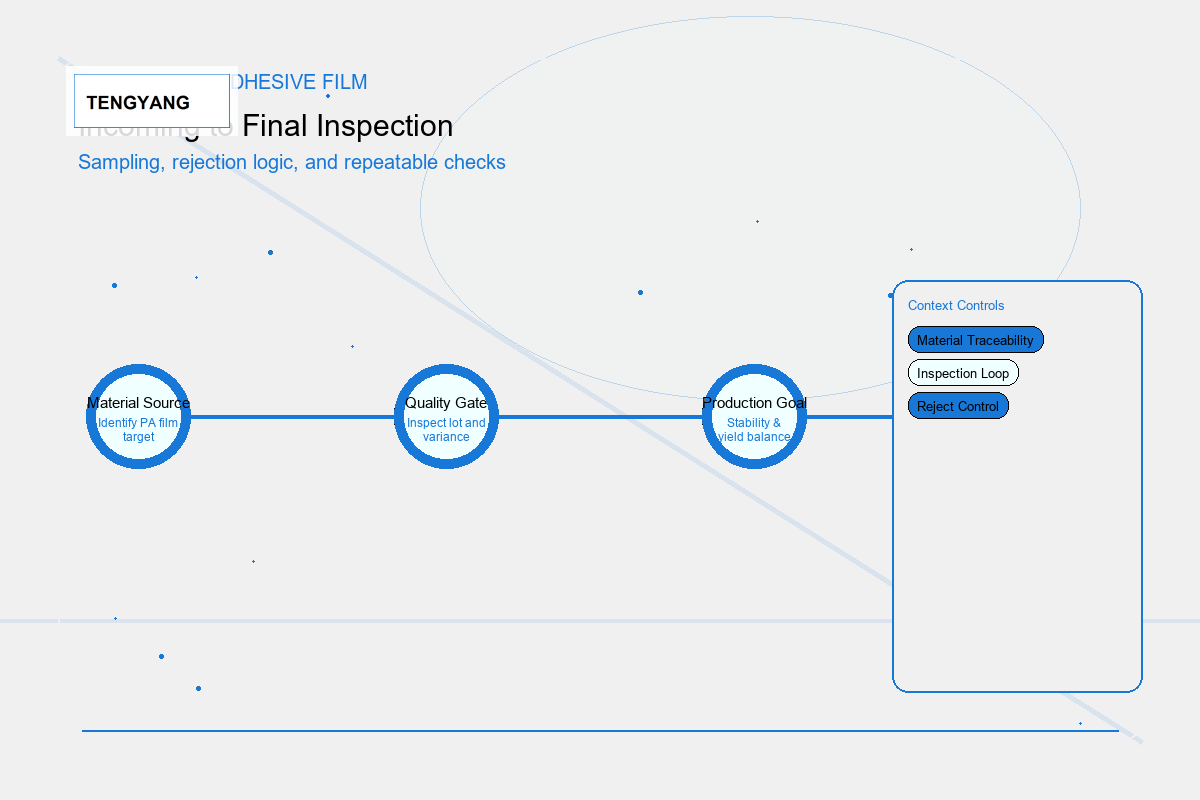
Quality systems for PA film should be front-loaded before production. Build a checklist for every shift:
- Film incoming lot temperature behavior and appearance.
- Moisture and storage condition verification.
- Preheat and melting consistency check on first 20 pieces.
- Cross-section bond profile sampling at predetermined checkpoints.
- Peel strength trend tracking and reject pattern logging.
When this workflow is consistent, teams gain two advantages: earlier alarm detection and lower variance in in-process yield.
7) Design for Maintenance and Lifecycle Value
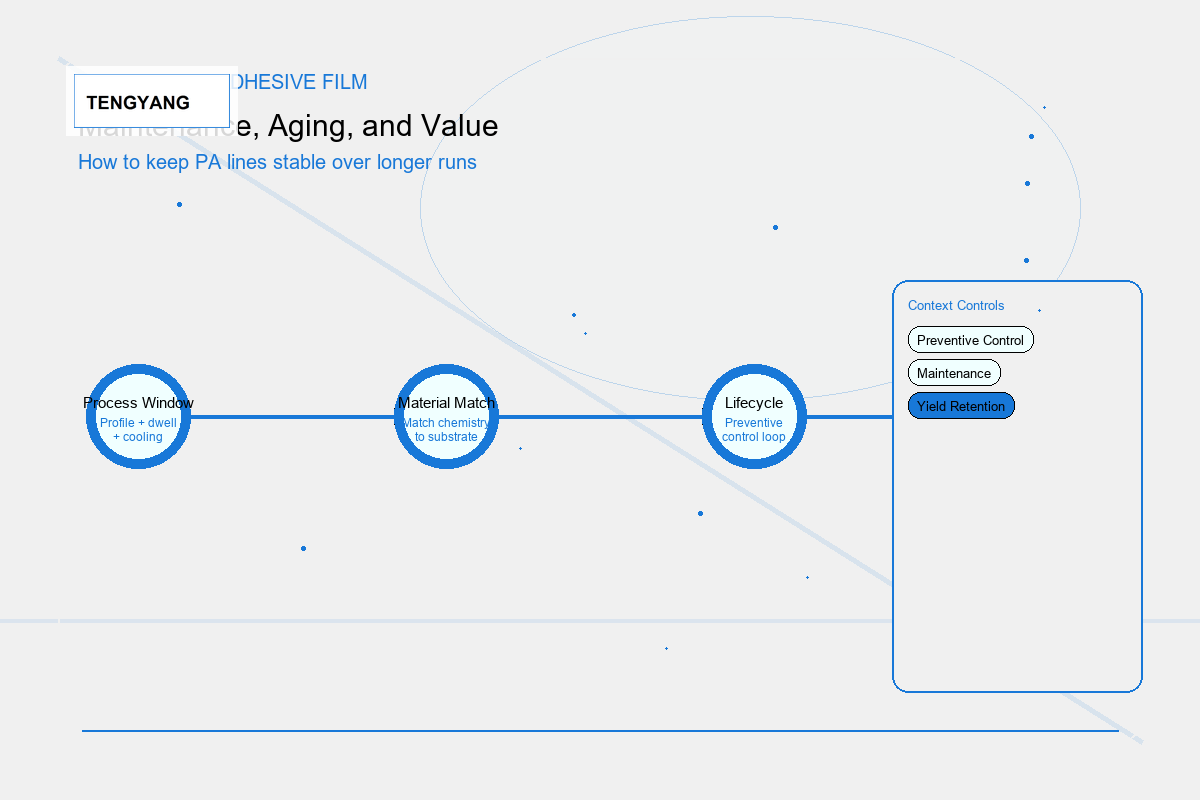
PA hot melt systems are often purchased for immediate production goals, but mature teams view adhesive film like any other production asset: with preventive care, preventive monitoring, and continuous data loops.
Operationally, prioritize:
- Spare profile control: keep baseline parameter snapshots for each product run.
- Preventive cleaning: especially around transfer zones and delivery rollers.
- Failure review cadence: weekly review by process owner and quality owner.
- Supplier feedback loop: share production findings so material selection evolves with real data.
8) Deep Comparison with Common Alternatives
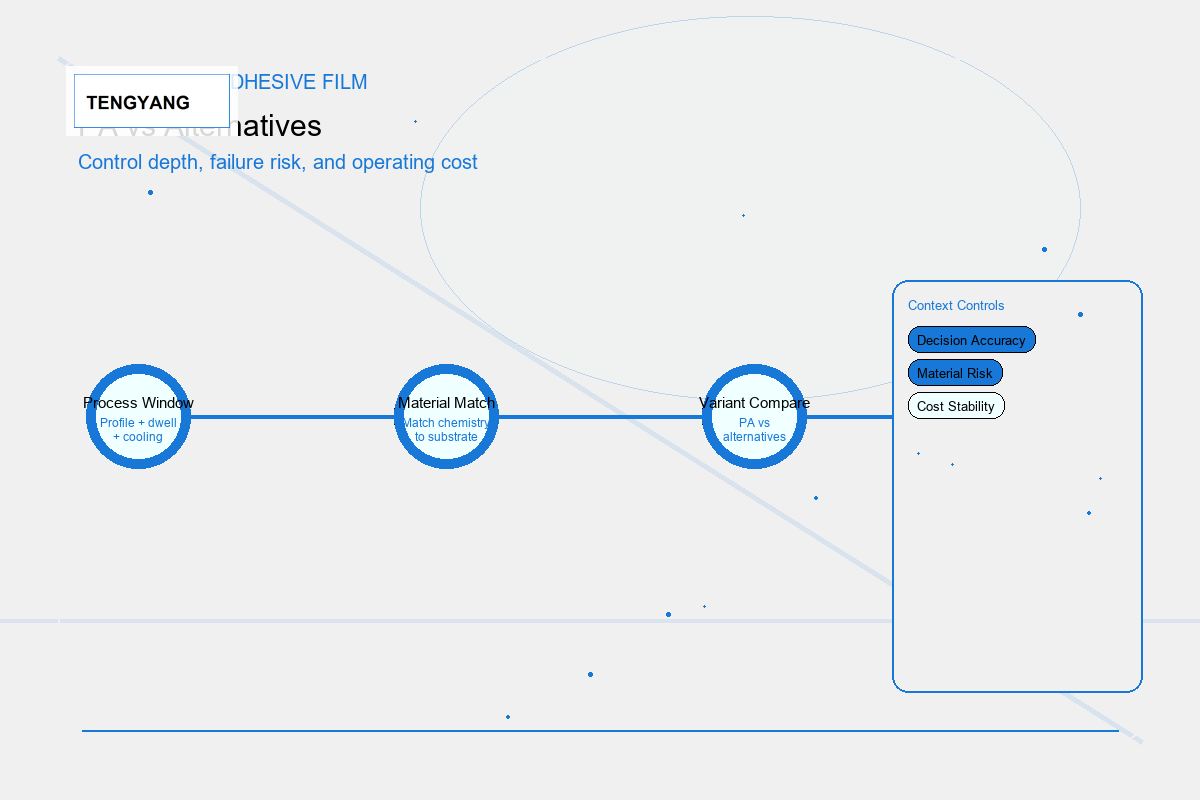
How PA film compares with alternatives depends on your constraints:
| Choice | Best for | Typical trade-off |
|---|---|---|
| PA hot melt film | Repeatable line conditions, automation, uniform dosing | Requires stricter process control and thermal consistency |
| Other hot melt chemistries | Different viscosity or opening windows | May reduce process flexibility if your line already tuned for PA |
| Solvent-based systems | Specific chemistry compatibility | Drying/cure dependencies and handling complexity |
9) Frequently Asked Questions
Is PA hot melt adhesive film suitable for continuous production lines?
Yes, when thermal profile, dwell, and pressure are stable. Its main advantage is repeatability if the line is controlled consistently.
![Fusible Web Explained: Industrial Bonding Web Guide [2026]](https://tengyangfilm.com/wp-content/uploads/2026/07/fusible-web-explained-industrial-bonding-web-guide-featured-768x512.png)
![Fusible Web Explained: Industrial Bonding Web Guide [2026]](https://tengyangfilm.com/wp-content/uploads/2026/07/fusible-web-explained-industrial-bonding-web-guide-featured-150x150.png)