Polyurethane Film (PU Film): What the Name Covers, and the 6 Products Sold Under It
Polyurethane film is a flexible polymer sheet made from the reaction of diisocyanates with polyols, and the same three words are commercially used to describe at least six materially distinct products. PU film and urethane film mean the same thing. TPU film does not – thermoplastic polyurethane is the subset of polyurethane that can be re-melted, and most polyurethane can’t.
The short answer: if a supplier quotes you “PU film,” you haven’t yet been told what you’re buying. Ask one question – can it be re-melted? That single answer separates thermoset polyurethane from thermoplastic polyurethane, and it decides how the film is converted, whether it bonds by melting or by glue, and whether your scrap is reprocessable.
PU Film, Urethane Film and TPU Film, What Each Name Actually Buys You
Search for polyurethane film and the first page of results will offer you a car wrap, a wound dressing, a roll of craft fabric backing, and an engineering-grade plastic sheet – all under one name. That isn’t a search engine failure. It reflects how the term is actually used in trade: polyurethane names a chemistry family, not a product.
Buyers pay for this ambiguity in real ways. On a manufacturing forum, one buyer had to explain that “TPU is naturally breathable which is a problem for my product” – the property every supplier markets as a benefit was the thing disqualifying the material.[2] Another asked plainly whether rubberized TPU could be melted at all.[3] These aren’t novice questions. They’re what happens when one name covers six things.
Thick cast urethane strip, a sheet-metal consumable
Laid over a die
No
PUL / PU fabric
A polyurethane coating on a textile — not free film
Coated or laminated
No
Hot melt adhesive
TPU engineered to a melting point so it bonds
Extruded; heat activated
Yes
The Crosslink Line
Every one of those six splits on a single question, and the industry’s own literature draws the line in the same place.
Thermoplastic polyurethane is, in the plainest published definition, “any of the polyurethane polymers that are thermoplastic; that is, they become pliable when heated and harden when cooled. This is in contrast to most polyurethanes, which are thermosets, hardening irreversibly.”[1]
Note what that says: most polyurethane is thermoset. TPU is the minority case – the re-meltable branch of a family that mostly isn’t.
A common shorthand says “TPU has no crosslinks.” That’s wrong, and the correction matters commercially. TPU’s hard segments aggregate into crystalline domains that “act as physical cross-links, which account for the high elasticity level of TPU” – but these “pseudo crosslinks … disappear under the effect of heat,” which is exactly why extrusion, injection moulding and calendering work on it and why “TPU scrap can be reprocessed.”[1] Thermoset polyurethane is crosslinked chemically. TPU is crosslinked physically, and heat undoes it.
Core Distinction
Why this isn’t academia
A hot melt film works because its physical crosslinks melt out under the heat press, the polymer flows into both surfaces and the physical crosslinks form again as the film cools. A thermoset PU is completely unable to do this. This distinction appears in the patent claims too: WO2011160912A1 describes a laminating adhesive “based on thermoplastic, non-reactive polyurethanes”[4], US9458363B2 a laminating adhesive with an “NCO-reactive polyurethane prepolymer”[5] and US20200325369A1 a two-part system[6]. Non-reactive remains thermoplastic. Reactive and two-part cross on application.
The PU Film Grades You’ll Be Quoted, Polyester vs Polyether
Assuming you’ve decided you want a thermoplastic film, the next choice point is the soft segment.
Commercial TPU divides ‘mainly into two groups’: those based on polyester (from adipic acid esters) and those based on polyether (from tetrahydrofuran ethers).[1] A third type of soft segment, polycaprolactone, does exist for specialist applications, but isn’t one of the two common types you’ll be offered.
Most supplier data sheets in this product category will at this stage show you a tidy grid. Polyester scores high for mechanical properties and chemical resistance, polyether TPU for hydrolytic stability and low temperature flexibility. That grid is broadly accurate and directionally useful[1]. It’s not the full story though, and the producer of the polyurethane itself says so.
The Data Nobody Quotes
In their Elastollan technical guide, immediately before the graphs illustrating hydrolysis resistance, BASF states “it isn’t always possible to achieve a clear separation of the effects described below.”[7]
The supplier is telling you that the x-axes interact. More plainly, a polyester-vs-polyether chart suggests choices, but doesn’t dictate them, and any actual TPU grade will be a compromise between cost, hydrolysis and mechanical performance that no single letter grade conveys.
Beware the Data, Too
One of the material databases listing over fifty commercial TPU grades lists yield for tensile strength as between 0.8 and 70 MPa (116 – 10,200 psi), averaging 21.8 MPa. Elongation to break ranges from 4.2% to 1000%.[8]
If anyone offers you a value for ‘TPU film’ without mentioning a grade, it’s probably a value from within that 2 orders-of-magnitude range.
Hard Segment Divisions: Aromatic vs Aliphatic
Where there’s a much more solid commercial division is the hard segment – aromatic or aliphatic. Aliphatic TPU will be the one chosen when UV resistance and colour stability (no yellowing) are a concern.[1] These are completely separate production lines, and the specialist press is well aware of it.
“Our specialty is aliphatic polyurethane film and sheet. Stevens is very good at extruding aromatic TPU film and sheet.”
Guy Broadbent, on Argotec’s acquisition of Stevens Urethane, Plastics News, 2014[9]
This is why getting the grade wrong is a real production risk, not a rounding error. Teng Yang runs hot melt grades across five chemistries — TPU, EVA, PA, PES and PO — and we ask for your substrate and process before naming one precisely because no single line is best at everything: a PES grade built to survive dry-clean cycles is the wrong call for a low-temperature EVA bond, and the trade-off between wash resistance, melting point and hand does not show up in any letter grade. Whereas a supplier that claims every chemistry with equal confidence is the one to check twice.
Two Extrusion Competencies
Two companies, two extrusion competencies, and an acquisition to hold them. A supplier quote, especially from a vendor that will confidently supply any grade at any time, should be tucked away for when needed.
Teng Yang runs hot melt grades in five chemistries — TPU, EVA, PA, PES and PO — and there is no all-rounder among them. When we ask for your substrate and process, it is precisely because a PES grade built to survive dry-clean cycles will ruin a low-temperature EVA bond, and pretending otherwise is how rolls end up in the discard bin.
Not sure which chemistry your substrate needs?
Send your bonding spec and we will match a grade to your process, or tell you plainly that none of ours fits.
An honest map of this polymer is broad. Extruded films and sheets of thermoplastic polyurethane appear in medical devices, textile lamination, footwear, inflatables, hose and cable jacketing, and laminated glass interlayers.[1] Trade coverage of one specialty extruder lists its film going into “breathable medical tapes, weatherable film for automotive paint protection, backing for automotive foam-in-place seating” from the same plant.[13]
Out of Scope Boundaries
Three of those are outside our scope, and we would rather say it here than let you find out after a sample ships.
ERR_01
Automotive paint protection
A different product with a different topcoat, sold into the automotive industry after market. If road debris, self-healing topcoats or UV protection for painted panels is your problem, you want a PPF converter, not us.
ERR_02
Medical wound care
Transparent film dressings, maceration management, surgical drapes and catheter securement sit in a regulated space with its own biocompatibility evidence requirements. Products like Tegaderm defined that category. Our medical grade tpu film page is the right starting point, and biological evaluation belongs to the ISO 10993 series – a device-evaluation framework, not a film specification.
ERR_03
Press-brake die film
A sheet-metal forming consumable that shares only a name.
Core Engineering Capabilities
What sits squarely inside our scope
is industrial applications of bonding. In every one of those, the film is not the product – it is what holds the product together.
Garment Accessories
Underwear
Footwear
Leather Lamination
Heat Transfer Printing
Reflective Materials
Automotive Interiors
Packaging
Building Decoration
Working in one of those industries?
Send your material, process, temperature, width and thickness → and our team will tell you which adhesive grade fits — or that none of ours does.
Properties That Actually Differ, and How They’re Measured
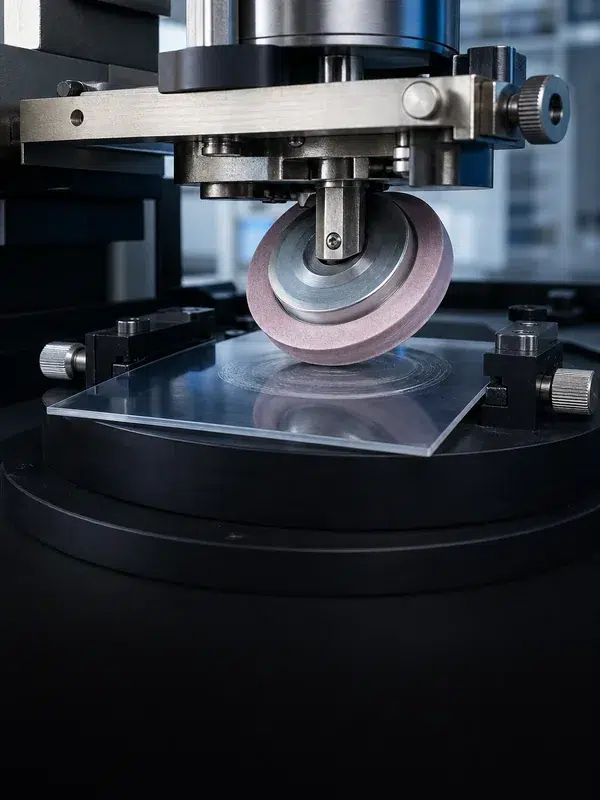
Polyurethane’s reputation rests on abrasion resistance, and understanding how that reputation is published — before you compare the numbers in two grade sheets — makes a real difference. Wear resistance, or abrasion, is reported in milligrams lost: abrade a specimen on a rotary machine, then weigh the remnant, and the lower the loss in milligrams, the better. That number comes from a repeatable load path rather than a hand test.
The Taber Test Reality
This trick can kill your budget: A table lists “4 mg wear loss” while a competitor lists “24 mg”. Results only compare if you know the exact Taber test parameters.
Unless the table details wheel, pressure, cycles, the data is meaningless. Vary the load from 250g to 1000g, and the film sheds many more milligrams.
Letter-Grade Tables
A/B/C/D grade tables indicate direction within a family. Don’t use them to select an individual grade or in lieu of a specific data sheet.
This family-wide data shows the interplay of hydrolysis resistance vs mechanical strength, which can’t be cleanly separated anyway.
Specification Stakes
Always demand the grade designation, test conditions, and ASTM standards. Never settle for marketing tables. That’s how we quote Teng Yang hot melt grades.
A heat-transfer printer bonding at 130°C, and a laminator pressing at 150°C, can’t run the same grade without scorching.
Flexibility & Breathability
Low temp flexibility is where polyether grades earn their place, staying mobile below freezing down to −60°F, while ester grades stiffen.
Breathability is measured as MVTR. A hydrophobic film passing vapour does two jobs, which is why your RFQ needs the MVTR figure.
Tengyang TPU Film Intelligent Manufacturing
Exploring our smart production lines, cutting-edge laboratories, dust-free workshops, and our strategic global business footprints.
VISIT-01
Customer Visit Factory Exterior
01 // 22
SECTOR.01 / OVERVIEW
PU Hot Melt Adhesive Film What Teng Yang Actually Makes
laminates fail at the bond line. Not at the film, not at the fabric - at the interface. Converters describe delamination as the most common lamination flaw, "where the adhesive bond between layers breaks down, causing peeling, curling, or complete separation,"[14] and practitioners trace it to causes as mundane as incorrect coating weight, incompatible substrates, or insufficient adhesive activation.[15]
Those experiencing the consequences are more blunt. A laminated technical fabric user “in month two” experienced a failure with “no off trail use.” They suspect it is “really apparent in frameless packs,” where flexibility is maximized.[16] This is the price of an bond line driven by cost.
In that same discussion thread, a user explained why another construction had held up, unprompted and better than most supplier copy: the film, they noted, was “melted on so it won’t” delaminate.[17]
"Customers send us the two materials and the press they already own. The bond is designed backwards from that — the melting point has to sit under whatever the fabric can survive, or the spec is wrong no matter how strong the adhesion number looks."
SECTOR.02 / MECHANISM
Thermoplastic Activation
And this is the entire mechanism. A hot melt film does not reside as a third layer between two others with two separate lines of adhesive to fail. Heat and pressure cause the polymer to melt and flow, rebonding at the interfaces while melting its own cross-links; because the resulting bond is the film rather than some thing added to it, there is no solvent to evaporate or cure to complete - hot melt adhesive is 100% solids and adds no solvent VOCs to your facility.[18]
A patent describes this same concept from the film formulation standpoint: a hot melt laminating adhesive that comprises “at least 75 wt % of a thermoplastic polyurethane 5000 to 40000 g/mol.”[19] High MW, non-reactive, thermoplastic. The film is the adhesive.
SECTOR.03 / COMPLIANCE
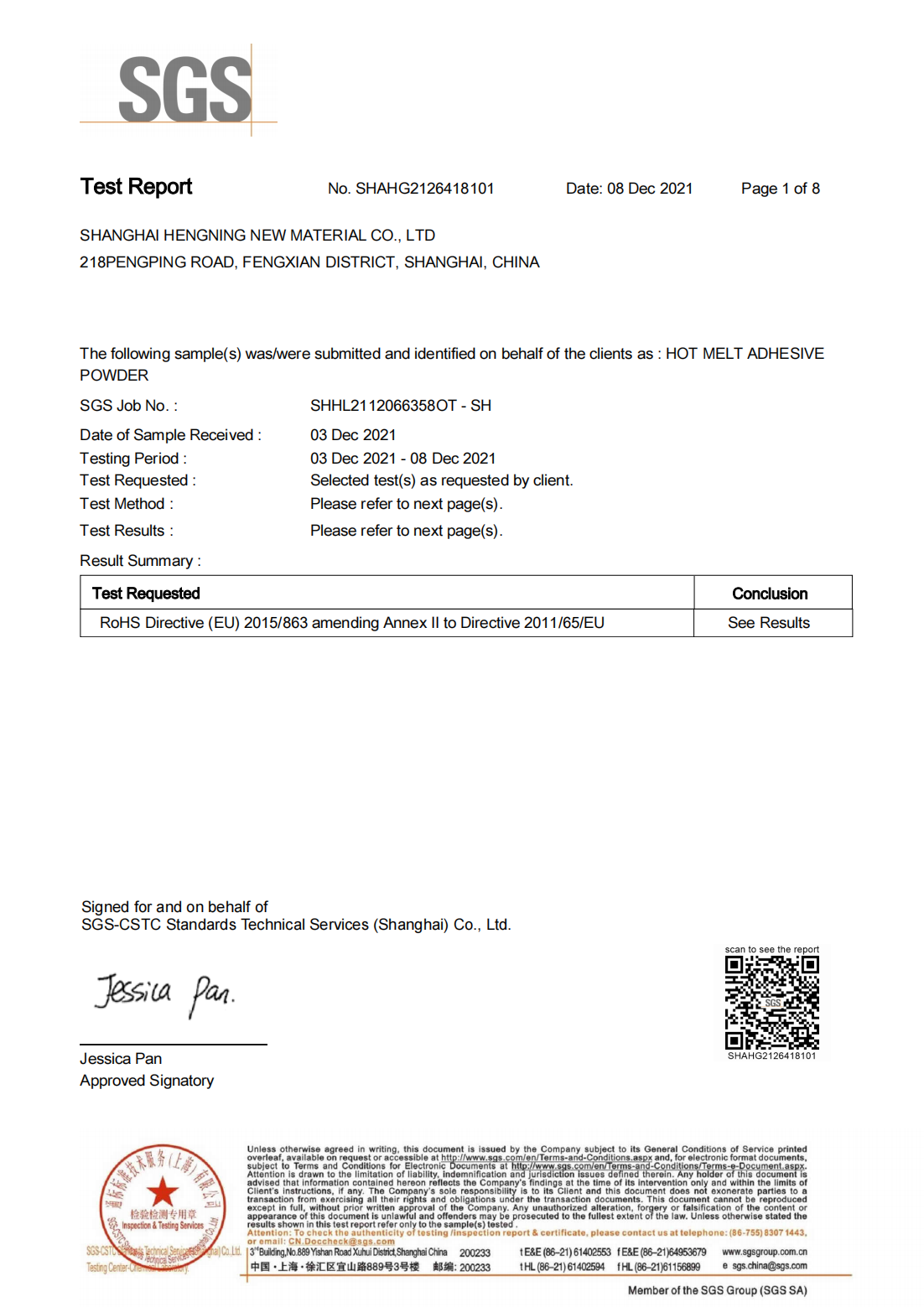
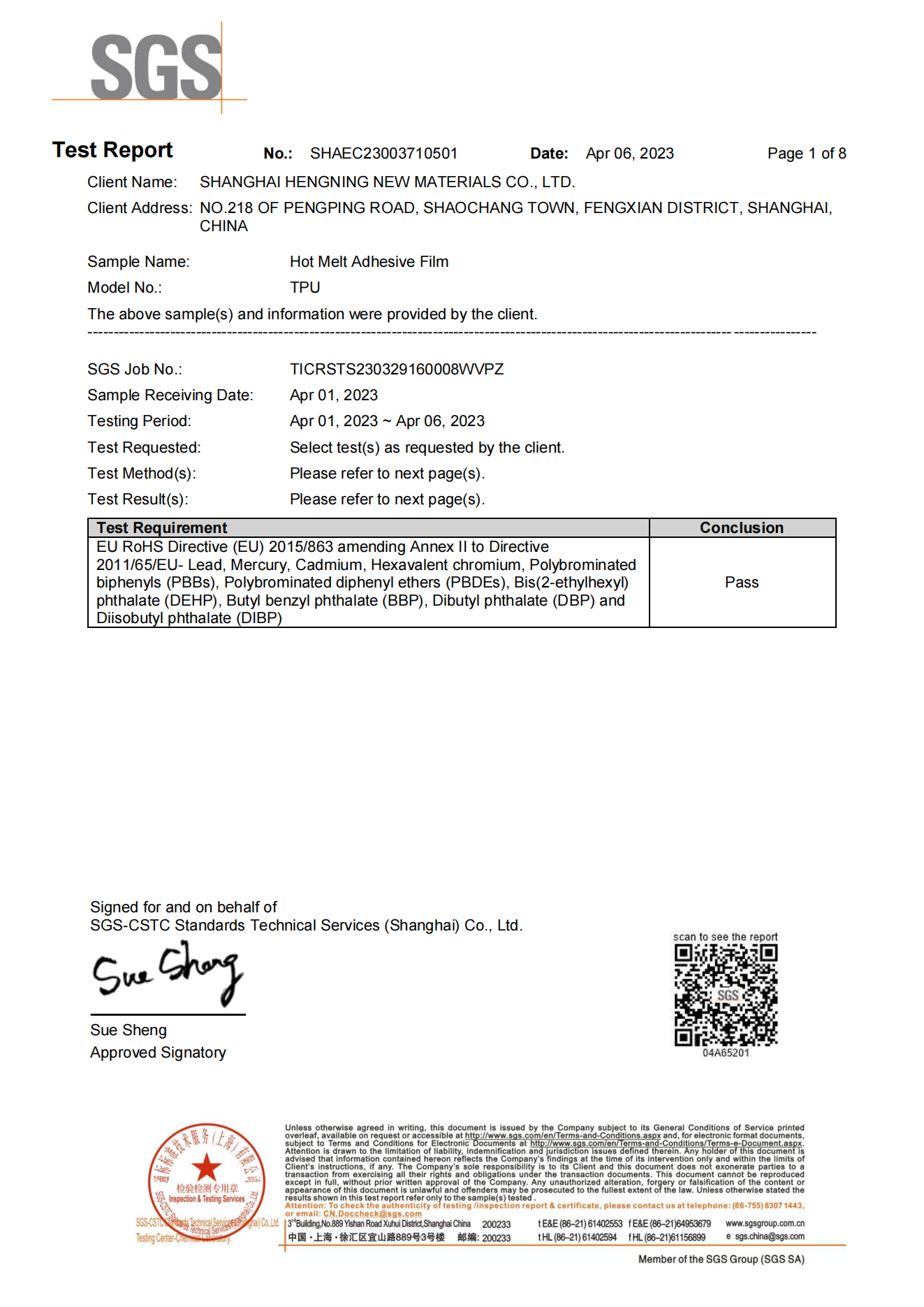
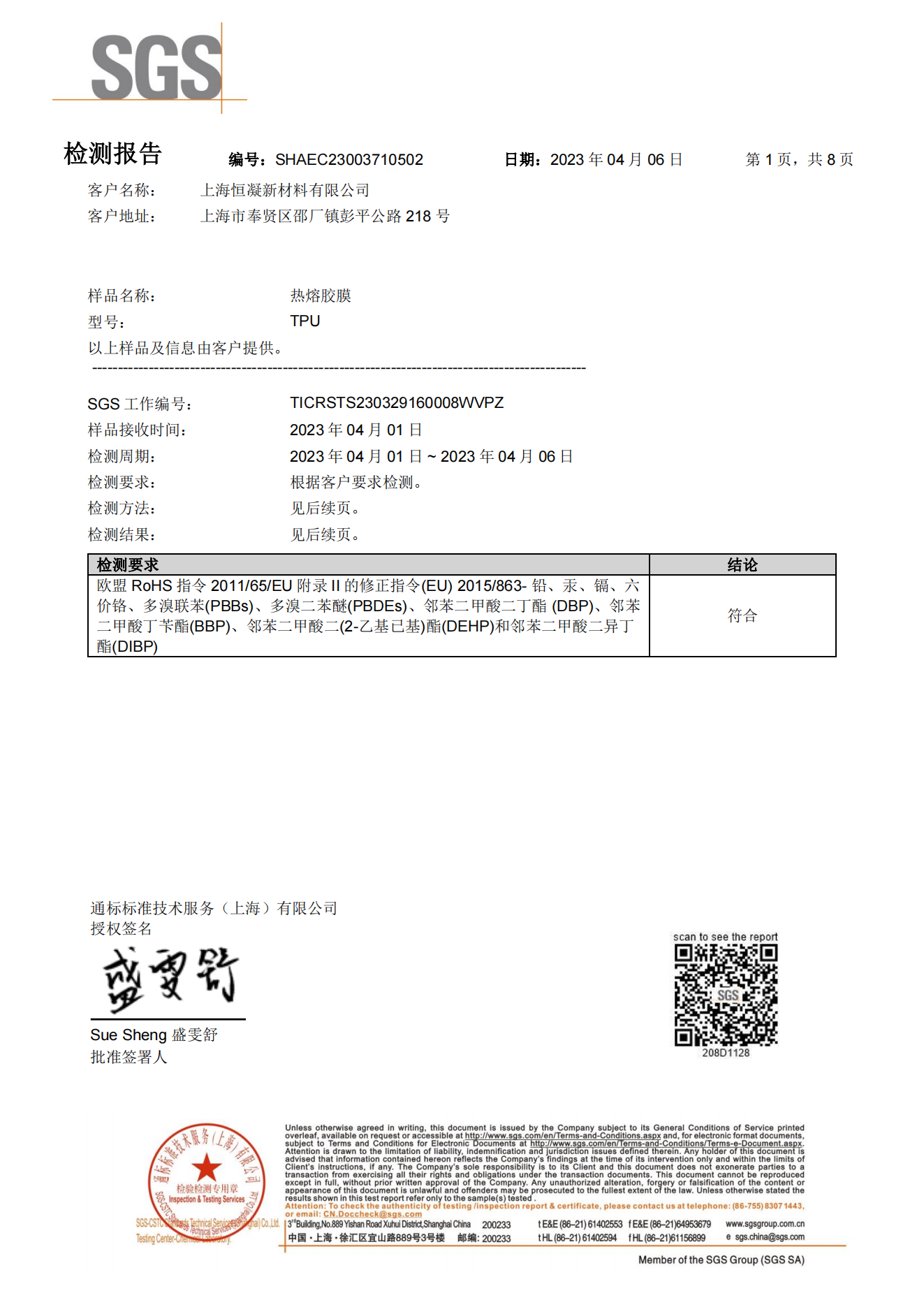
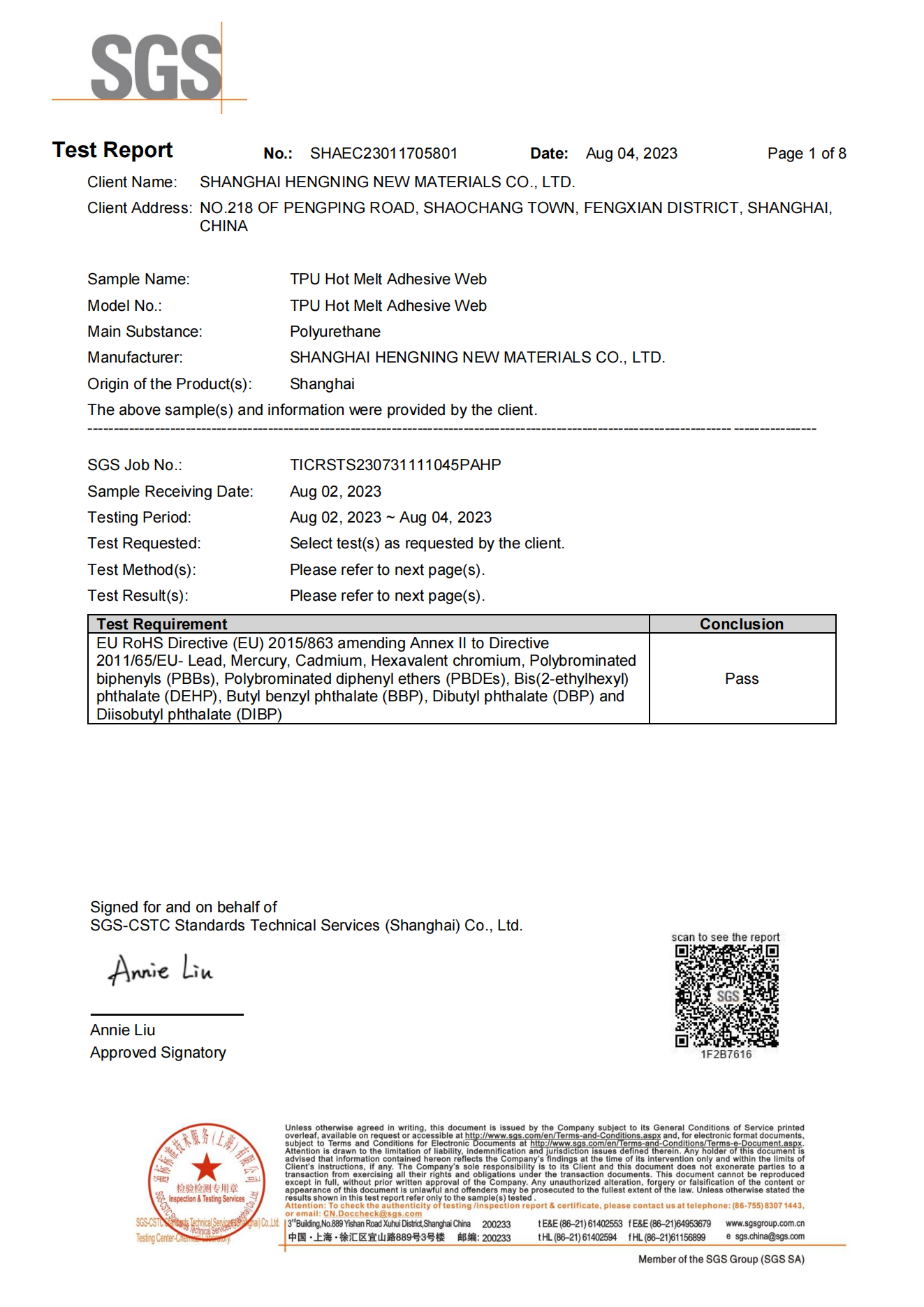
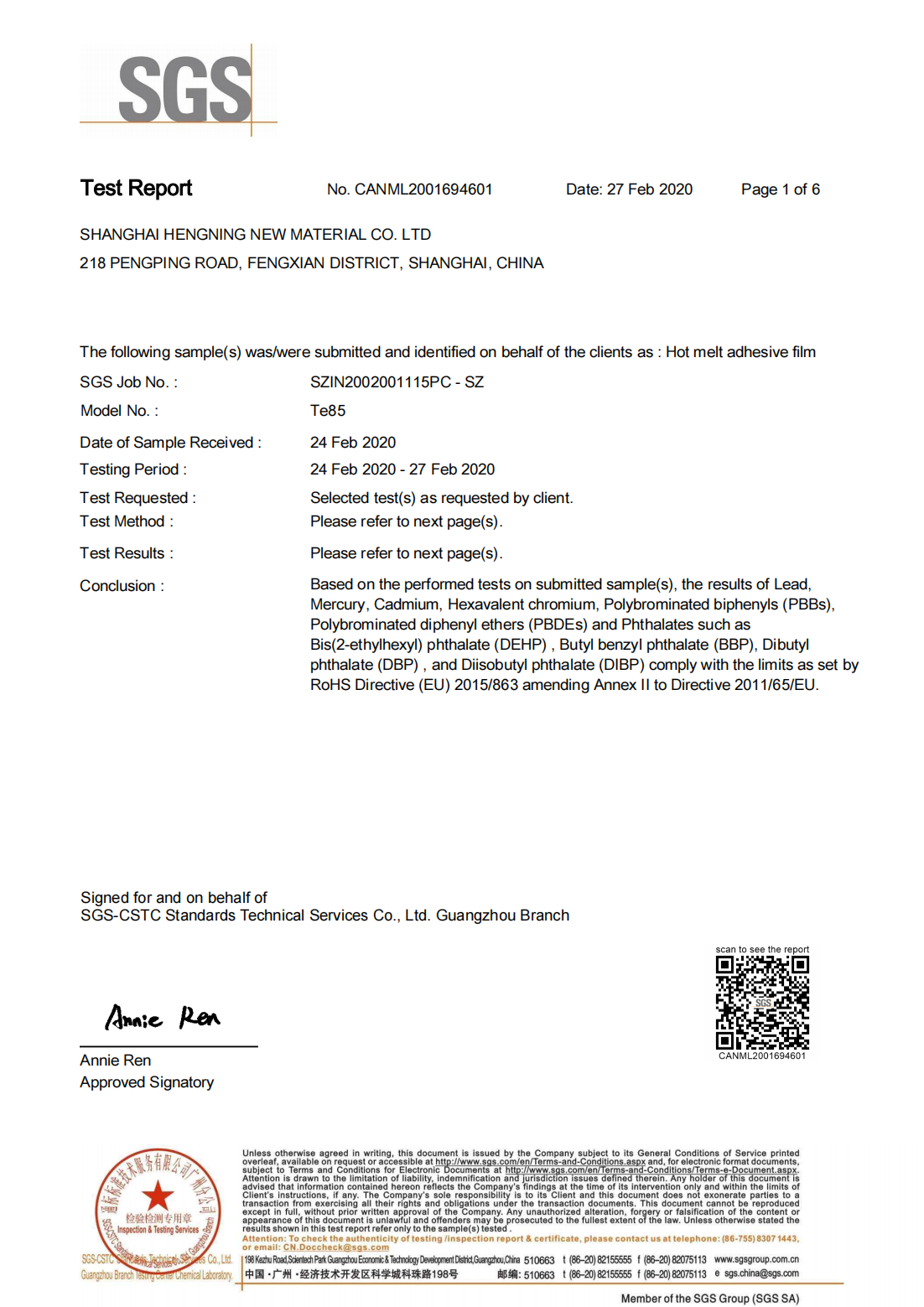
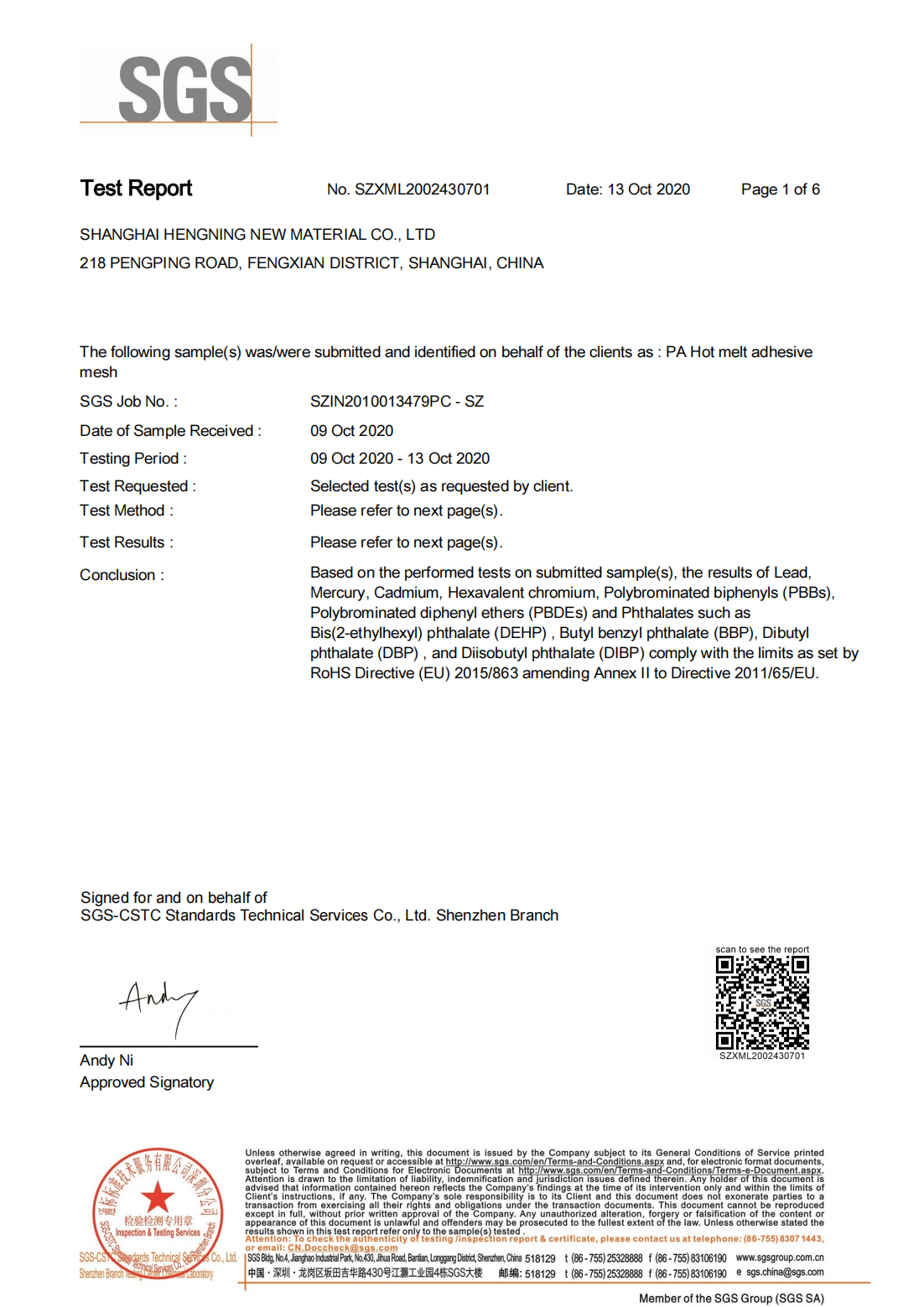
Authority Certifications
SECTOR.04 / MATRIX
Custom Manufacturing Setup
Teng Yang supplies TPU, EVA, PA, PES, and PO chemistries in hot melt adhesive films, webs, powders, and granules. The activated element in this group is heat and pressure; ultrasonic, high-frequency, hot air, infrared and impulse sealing are all in the same family.[20] We are an OEM film producer, custom manufacturing thickness, width, melting point, color, and application specific formulations - this is why this page concludes with an RFQ instead of a specification table. A specification is a process output, not a menu.
Independent procurement checklists for this material converge on a similar set of dimensions, and the useful ones will call out tolerance range rather than nominal values. An RFQ lacking these will be priced based on a film that’s not yours.
01RFQ Specs Telemetry
02Pricing Tolerances
03System Transparency
Initialize Contact_>
Data Node: RFQ Specs
Price for the same nominally specified polyurethane thin film from two different suppliers can vary by one-third once gauge tolerance, slit width, and roll format are settled; price for a tpu film roll is meaningless until core size and put-up are known.
RFQ Parameter
Variance Impact
Commercial Output
Chemistry (TPU/EVA/PA/PES/PO)
Sets melting point, wash and chemical resistance, adhesion
Five families in common industrial supply
Thickness + Tolerance
Drives coat weight, hand, and cost per m²; biggest lever
0.2–125 mil across US suppliers; .001″–.080″ at specialty extruders
Width Matrix
Determines slitting waste against press or laminator
Up to 85″ across US suppliers; to 66″ at one extruder
Shore A Hardness
Governs hand, drape and peel behaviour
70–95 Shore A is commercially offered
Roll Format & Length
Bulk format shifts unit cost materially
Medical PU film at $135/5ft bag vs $1,025/50ft roll (~24% variance)
Pricing Logic Module
// System Warning: Activation Temps
Published TPU hot melt film activation temperatures vary wildly from supplier to supplier -- one states it melts "typically in the 70s [C]", another reports service "from 40 to 120 degrees [C]", a third reports "110 degrees" and "minus 20 degrees". Not one specifies a grade. They aren't disagreeing as much as they're describing different products with the same name. Assume any activation figure - even from us - is meaningless unless tied to a specific grade and a test method.
// Cost Calculation Mystery
Every manufacturer we approached quoted based on application; the only clearly visible price online is from a marketplace listing. We will not claim a price per square meter because that price would be qualified into worthlessness. Your quote is about a trade-off you define, not one we will set for you. What we can tell you are factors influencing price: Chemistry, tolerance grade, sheet width, melting point, color, form factor, standard vs custom.
Compliance & Standards
// Data Sourcing Statement
Every performance data point herein comes from a public source and is not generated by Teng Yang. Tensile, elongation, abrasion and hardness values are provided as ranges commercialized by third parties for illustrative purposes, not as specifications for our product. We did not test these.
Teng Yang specifications will be documented on the datasheet delivered with your sample - tailored to your specific process. ASTM D883 defines terminology in plastics; ASTM D3389 provides a test for rotary abrasion; ISO 10993 is a standard for biological evaluation of medical devices; none is a specification for this film.
// REACH Regulatory Alert
Thermoplastic polyurethane may contain siloxanes, several of which are on the EU candidate list of Substances of Very High Concern. If your product is sensitive to REACH, mention this during the RFQ process.
HMI CONTROLS
HUD Opacity80%
Data Pulse60%
System FreqNORM
Evaluation Module
Interactive PU & TPU Film Tools
01
PU or TPU? The one-question test
“PU film” and “TPU film” are quoted as if interchangeable. They are not. Answer one question to see which family your job needs.
Independent procurement checklists converge on the same fields — and a quote for the wrong spec is worse than no quote. Fill what you know; leave the rest blank and we will help pin it down.
Here are the questions left unanswered on which a buyer often picks the wrong roll - the naming confusion leading to the mismatched shipment, the assumptions about performance characteristics resulting in press failure. Below is a succinct summary of decisions that might otherwise require a production run to resolve.
pu film is a name for the entire family of polyurethane. tpu film is a name specifically for the thermoplastic branch - that family which is pliant when warm, hard when cool. Most polyurethane sets permanently when heated and is therefore called "thermosetting".[1] Thus all TPU film is a form of PU, but not all PU film is TPU.
No - it's a subset. TPU is "any of the polyurethane polymers that are thermoplastic."1A common source of incorrectly specified material on the receiving dock is calling TPU and PU by the same name.
For films, yes. "urethane film", "pu film", and "polyurethane film" are interchangeable terms for the same material. If you want to include the thermoplastic word you must do so where it adds information.
Neither; the question typically contains another unasked question. If the goal is to be able to remelt, re-form, weld, or recycle the material at end-of-life, then thermoplastic - TPU is required. If the goal is to produce a permanently crosslinked part that will not ever become soft, a thermoset PU is correct. The quality is determined not by quality but by reversibility.
Yes for some grades but should be quantified rather than simply asserted. Breathability is given in the form of MVTR - which refers to water vapour transmitted grams per day per square metre through the film in a certain time and area.[12] Waterproof to liquid and breathable. You can find the actual figures; ask for MVTR and for testing conditions.
Unsupported polyurethane film is a non-porous barrier and blocks liquid water. Water-resistance for the final laminate comes down to the seams, or the bond line - not the film itself. The latter is where most failure is encountered in the field.[14]
It is a class of material that is located between rubber and plastic in behaviour. A thermoplastic elastomer is a TPU - that stands for linear segmented block copolymers of hard and soft blocks which behave much like a rubber when deformed but like a plastic during fabrication. [1]
thermoplastic grades are capable of reprocessing - the so-called 'pseudo-crosslinks' giving elasticity to TPU can be melted down so scrap may be re-extruded. [1] A thermoset PU may not be remelted. 'The notion of mechanical recycling as a 'down-cycling' activity, especially concerningpolyurethane, appears to be flawed. Recent research contrary to established belief is reporting encouraging results'. [28]
As a result, for many films it is advisable to request samples, but for a film that is meant to perform as an adhesive you must request them based on your application, not a spec sheet in a vacuum. We have an in-house formulated range of Teng Yang hot melt grades for hot melt laminating films across TPU, EVA, PA, PES, and PO films, so the best test of quality is how the sample performs when laminated to your product using your process parameters and on your machine - if a bond will hold up after your cleaning/service cycle on a 5-piece trial, it is more valuable than a numerical tensile result on a paper.
Request a sample roll for your process → and we will find a grade that matches the job, or tell you flat-out if we don’t make one.
Tell us the bond, not the part number
Please send samples of the two materials to be laminated, along with the width and thickness required for the film, and the temperature limitations for the equipment on which the film will be used. We will find the hot melt adhesive film grade that matches your application requirements, or inform you straightforwardly that we do not.







![Oz per Square Yard to GSM [Formula, Chart & Calculator]](https://tengyangfilm.com/wp-content/uploads/2026/08/oz-per-square-yard-to-gsm-featured-150x150.png.webp)
![Garment Accessories TPU Film [Production Guide]](https://tengyangfilm.com/wp-content/uploads/2026/07/garment-accessories-tpu-film-guide-featured-1-150x150.png.webp)


