
Get in Touch with Teng Yang Company


Updated August 2026 · Industrial buyer and converting guide
TPU sheet vs TPU film is a format choice: TPU sheet and TPU film can be made from the same thermoplastic polyurethane grade; the decisive difference is often how the material is dimensioned, presented and handled. Use roll film for a continuous, tension-controlled process and cut sheet for discrete loading or flat-part handling only after chemistry, thickness, tolerance and validation conditions match.
Direct answer: Do not approve a quotation from the words “film” or “sheet.” Fix seven fields: grade, nominal thickness and method, tolerance, width/length, delivery presentation, converting process and validation lot. If any field changes, the formats are not yet equivalent.
TL;DR: A format name is a routing clue, not an acceptance criterion. Compare usable material at the machine, including winding, liner, flatness, blocking, scrap and changeover. Then test a representative production presentation, not only a hand-cut sample.
TPU Sheet vs TPU Film at a Glance

The same TPU formulation can be extruded as thin flexible stock, wound into a roll, slit to width and later cut into pieces. Another supplier may call the cut pieces “sheet.” A thicker grade can also be sold flat from the start. The name alone therefore cannot prove material identity or process fit.
| Decision factor | Roll film is usually the better starting point | Cut sheet is usually the better starting point | Do not assume |
|---|---|---|---|
| Material feed | Continuous unwind, lamination, coating or automated cutting | Manual loading, fixtures, prototypes or discrete parts | Either format will run without feed trials |
| Purchase dimensions | Thickness, width, roll length, core, winding and liner | Thickness, width, length, flatness, interleaf and pack quantity | “Sheet” means a universal thickness |
| Main handling risk | Blocking, telescoping, stretch, wrinkles and web tracking | Curl, stacked blocking, edge damage and misregistration | Cutting a roll removes all format risk |
| Economics | Can reduce handling at sustained volume | Can avoid in-house slitting or cutting for discrete demand | Lowest price per kilogram gives lowest part cost |
| Search-language trap | “TPU film and sheet” or “TPU sheet roll” | “TPU sheet 0.5 mm” or another gauge phrase | Any search phrase is a complete purchase specification |
ASTM D882-26 uses “film” as an optional term for sheeting with a nominal thickness no greater than 0.25 mm within that test method. That is a useful terminology note, not a universal commercial naming law. Buyers should put a numeric thickness and the required roll or cut-flat presentation on the drawing and purchase order.
If the project first needs material fundamentals, separate TPU material identity from delivery format. For current grades and supplier-owned capability fields, check which Teng Yang grades can be quoted in roll or cut form. This guide stays focused on the delivery-format decision.
What Suppliers Mean by Film, Sheet, Roll Stock and Cut Pieces
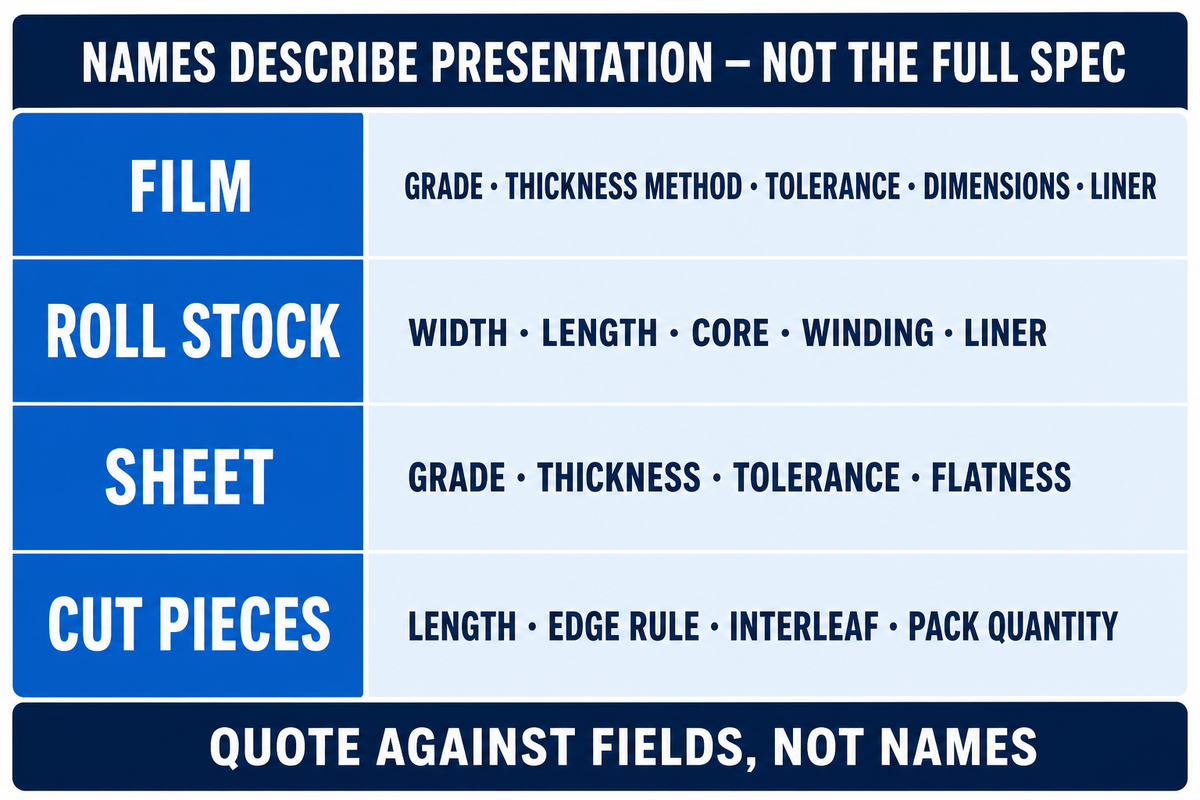
Four phrases often describe overlapping products. Film usually suggests flexible, relatively thin stock. Sheet often suggests a thicker or flat piece. Roll stock defines presentation more clearly: material wound around a core. Cut pieces state that the converter has slit or cross-cut stock to specified dimensions. None of these phrases fixes chemistry, hardness, surface, tolerance or backing.
Roll description
State usable width, roll length or mass basis, core inner diameter, winding direction, splice rule, liner and maximum outside diameter.
Cut-piece description
State width, length, squareness or edge tolerance, flatness or curl rule, interleaf, stack orientation and pack quantity.
Shared description
State exact grade, thickness method and tolerance, hardness, surface, color, lot identity, storage and required documents.
How is TPU film thickness specified?
Use a nominal value, units, tolerance, measurement method, sampling locations and conditioning. If direction matters, record machine direction and transverse direction. Bare certificate text such as “0.20 mm” does not tell incoming inspection whether it is a target, a rounded catalogue value or an acceptance limit.
The practical translation is simple: make suppliers quote against fields, not against names. Roll stock made from the approved grade can be converted into valid cut sheets, but the cutting, stacking and packaging operation introduces new edge, flatness and blocking conditions. Conversely, a flat sample does not prove the full roll will unwind, track or laminate cleanly.
Quote-normalization example: “Clear TPU sheet” is too vague to compare. One controlled line could instead read: “approved thermoplastic polyurethane film grade; 0.20 mm nominal thickness with ±0.02 mm agreed tolerance; 600 mm usable width; 50 m roll length; 76 mm core; clear surface with agreed optical clarity; liner and winding direction declared.” The cut-format alternative would replace roll length, core and winding with exact piece length, flatness, orientation, interleaf and pack quantity. These dimensions illustrate complete field structure; they are not Teng Yang catalogue limits.
Thickness, Tolerance and Flatness: The First Format Trade-off

Gauge control matters before the film-versus-sheet label. Thickness affects material use, stiffness, heat transfer and some part-level load responses, while variation can disturb registration, lamination pressure or a formed geometry. The buyer should specify what is measured and where.
- Nominal thickness: the design target, with units.
- Acceptance tolerance: bilateral limits, unilateral limits or a stated range.
- Measurement method: instrument principle, foot pressure where applicable, conditioning and number of readings.
- Sampling map: across width, along length and by roll or sheet stack.
- Directional record: machine-direction and transverse-direction positions where process variation is relevant.
ISO 4593:1993 describes thickness measurement by mechanical scanning for plastic film and sheeting. ASTM D8136-24 addresses plastic-film thickness and variability, including machine- and transverse-direction information useful for incoming inspection and buyer–seller communication. Method scope does not create the purchase tolerance; the parties still agree that tolerance.
Tensile methods should not be used as naming rules. ISO 527-3:2018 covers tensile test conditions for films and sheets less than 1 mm thick, and ASTM D882 applies to thin plastic sheeting within its scope. “Less than 1 mm” describes a test-method range, not a universal point at which buyers must rename film as sheet.
Common specification failure: A drawing says “TPU sheet, 0.3 mm,” while the quotation says “TPU film, 0.30 mm roll.” The names differ, but the real open questions are grade, tolerance, method, width, winding, liner, flatness after cutting and validation on the buyer’s equipment.
For a deeper certificate and method checklist, map each quoted property to its test method and evidence.
Handling and Converting: Unwind, Laminate, Die-Cut or Thermoform

Use the presentation that best suits the physical route from package to finished part. Roll stock can eliminate redundant manual loading, but it imposes tension, tracking and winding control challenges. Cut sheets may save discrete steps, but they require flat storage and consistent orientation.
| Process | Preferred starting format | What to verify | Exception |
|---|---|---|---|
| Continuous lamination | Roll | Unwind tension, web tracking, splice rule, liner release and thermal response | Short runs may favor pre-cut kits |
| Automated die cutting | Roll or indexed sheet | Registration, stretch, nesting, liner and waste removal | Fixture geometry may require flat blanks |
| Manual assembly or prototype | Cut piece | Flatness, identification, orientation and edge condition | A small roll may better represent future production |
| Thermoforming or fixture loading | Cut sheet or blank | Heating uniformity, sag, orientation, shrinkage and clamp area | High-volume lines may feed blanks from a roll |
Blocking—unwanted adhesion between adjacent layers—deserves a purchase-level control. ASTM D3354-21 describes blocking in plastic film and identifies contact, pressure and temperature as relevant conditions. A roll can block between wraps; a cut stack can block face-to-face. Liner, interleaf, surface treatment, winding pressure, storage temperature and time all affect handling. Ask for a defined packing system and test it after realistic storage.
Highly extensible TPU can also challenge roll-to-roll handling. Do not infer that a material with good finished-part elasticity will behave like a dimensionally stable web. Trial unwind tension, acceleration, steering and nip conditions. Mark machine direction when orientation or dimensional response could affect cutting or forming. A hand-fed sheet may hide those variables; a production roll reveals them.
Chemistry Still Controls Resistance and Service Life

Presentation cannot offset a chemistry mismatch. TPU has at least two separate selection dimensions: the soft segment may be polyester, polyether or polycarbonate based, while the diisocyanate family may be aliphatic or aromatic. One grade can therefore be described on both axes—for example, polyether-based and aliphatic. Treating those terms as competing labels loses useful information.
| Requirement | Format can influence | Format cannot establish |
|---|---|---|
| Wet or hydrolytic exposure | Seam count and handling damage | A grade’s hydrolysis resistance |
| Ultraviolet and color stability | Surface exposure and protective packaging | Aliphatic versus aromatic response or additive performance |
| Oil, chemical or abrasion service | Part thickness and replaceable geometry | Compatibility, retention after exposure or wear rate |
| Low-temperature flexing | Section geometry | Grade-specific transition and cyclic durability |
The peer-reviewed TPU formulation review describes polyether, polyester and polycarbonate diols separately from aliphatic and aromatic diisocyanates. That supports the taxonomy; it does not predict service life for an unnamed commercial grade. First choose the service-fit TPU chemistry before choosing its presentation, then screen the exact grade before roll-or-cut approval.
Material terms procurement should not collapse
TPU is a polyurethane film material, but “PU” alone can also describe other polyurethane constructions. It is a versatile polymer family, not one property set. The table below keeps adjacent terms from becoming silent substitutions.
| Material type or term | Why it does not select roll or sheet | What the buyer must clarify |
|---|---|---|
| Polyether TPU films | Soft-segment identity does not specify delivery presentation | Exact grade, wet-service test and format |
| Polycaprolactone TPU | A chemistry descriptor does not establish winding or flatness | Commercial grade and verified property data |
| Aromatic or aliphatic TPU | Diisocyanate family is separate from roll-versus-sheet presentation | Color stability, exposure and exact formulation |
| PVC film | Polyvinyl chloride is a different polymer family | Do not substitute from format similarity |
| Polyethylene film | Similar appearance or density language does not prove TPU behavior | Material identity and test method |
| Breathable or waterproof film | These are performance claims, not format definitions | Moisture resistance or water-resistant test conditions |
| Protective films | The use label does not establish toughness or tear resistance | Surface, load, bend and abrasion tests |
| Print, seal or adhesion grade | Processing claims can depend on treatment and substrate | Ink, seal or adhesion properties under a named method |
| Automotive, fabric or foam grade | Industry and substrate labels do not define one specification | Layer stack, flexibility and service exposure |
| Chemical-resistant TPU | Chemical resistance varies by reagent, concentration, time and temperature | Relevant chemical classes, including any chloride exposure |
Is thicker TPU always more durable?
No. Greater section thickness can increase load capacity or wear allowance in a defined geometry, but tensile strength, tear propagation, abrasion, hydrolysis, ultraviolet stability and cold flexing still depend on grade, hardness, orientation, additives and test conditions. Compare conditioned specimens under the same method. A thicker piece made from the wrong chemistry can remain the wrong choice.
Application Fit: When Roll Film Wins and When Cut Sheet Wins

Roll film is the default candidate where material moves continuously through lamination, coating, slitting or automated conversion. Cut sheet is the default candidate where an operator or robot loads a discrete blank, where a fixture needs a flat piece, or where prototype demand is too small to justify roll handling. These are starting positions, not release decisions.
- For footwear lamination, roll stock can support repeatable high-volume feeding, but the buyer must validate stretching, registration, bonding and the actual layer stack. Before release, check roll-fed footwear lamination constraints.
- For medical or skin-contact constructions, roll processing may fit coating and converting, yet application-specific biological, chemical and quality requirements dominate the decision. Supplier category pages are not device approvals; identify available medical-application film options without treating them as device approval, then define the applicable regulatory pathway independently.
- Protective membranes and textile laminates: rolls reduce seams and support continuous bonding. Verify web tension, bond line, hydrolysis needs and retained performance after exposure.
- Industrial liners, guards and formed parts: cut blanks can simplify placement and forming. Verify flatness, cut edge, sag, dimensional change and the finished-part geometry.
- Prototype or repair kits: labeled cut pieces may reduce handling and identification errors. If scale-up will use rolls, qualify a representative roll before production approval.
Production volume changes the economics but does not reverse the physical constraints. A low-volume cut-sheet trial can identify chemistry and thickness; it cannot prove roll tracking. A roll trial can prove continuous handling; it cannot prove stacked cut pieces will remain flat after storage. Validate the format that will actually arrive at the plant.
Cost, MOQ and Yield: Compare the Delivered Format, Not Price per Kilogram

The useful comparison is cost per accepted part or usable square metre at the line. Include material, conversion, packaging, freight, storage, setup, changeover, scrap, inspection and downtime risk. Minimum order quantity belongs in the same model because buying excess custom width can erase a nominal unit-price advantage.
Comparable-cost equation
Delivered cost per accepted part = (material + supplier converting + packaging + freight + incoming inspection + in-house converting + changeover + scrap + expected disruption cost) ÷ accepted parts.
Delivered cost per accepted part = (material + supplier converting + packaging + freight + incoming inspection + in-house converting + changeover + scrap + expected disruption cost) ÷ accepted parts.
Synthetic worked example, not a market price: Suppose a project needs 10,000 rectangular blanks. Roll Option A costs $4,000 delivered, requires $600 of setup and labor, and produces 8% total waste. Cut-sheet Option B costs $4,750 delivered, needs $150 of receiving and handling, and produces 2% waste. Before downtime or rejected parts, the illustrative costs are about $0.50 per usable Option A blank and $0.50 per usable Option B blank. The lower delivered material price did not create a clear part-cost win. Replace every value with supplier quotations and plant data.
Nesting can favor a wider roll for one geometry and create edge waste for another. Pre-cut pieces may reduce labor but add supplier converting charges, pack materials and minimum batch constraints. The 2024 peer-reviewed TPU extrusion study reported lot-dependent behavior associated with degradation, viscosity increase and particulate buildup. That evidence reinforces why yield is configuration-specific; it does not supply a universal roll-versus-sheet scrap percentage.
Ask both suppliers to quote the same usable width, tolerance, presentation and validation lot. If one supplier quotes a master roll and another quotes finished blanks, normalize the conversion boundary before comparing price.
The 2-Format Roll-or-Cut Release Board

The 2-Format Roll-or-Cut Release Board turns an informal format choice into a controlled purchasing decision.
Each candidate passes only when all seven fields match the application and the validation sample. Any blank field is an open risk, not permission to use a supplier default.
Illustrative record format, not Teng Yang catalogue data: keep units attached to every entry—for example, 600 mm usable roll width, 50 m roll length, 76 mm core diameter, or 600 mm × 800 mm cut-piece dimensions. Replace these examples with the supplier quotation and the buyer’s approved drawing.
| Material / format gate field | Buyer records | Choose roll when | Choose cut sheet when | Limitation |
|---|---|---|---|---|
| 1. Chemistry / grade | Exact commercial grade and required chemistry axes | Approved grade is available in a windable construction | Approved grade is available flat or can be cut safely | Format never substitutes for grade |
| 2. Nominal thickness + method | Value, units, method and conditioning | The method works across the web | The method works across pieces and stacks | Name-based thresholds are rejected |
| 3. Tolerance | Acceptance range and sampling map | Across-width and length variation is acceptable | Piece-to-piece and edge variation is acceptable | Nominal alone cannot pass |
| 4. Width / length | Usable dimensions and edge rules | Width fits feed and nesting | Blank size fits fixture and pack | Catalogue maximum is not a tolerance |
| 5. Delivery presentation | Core/winding/liner or flatness/interleaf/pack | Unwind controls are available | Stack controls prevent curl and blocking | Packaging is part of the product |
| 6. Converting process | Machine path, tension, heat, speed and fixture | Continuous feed improves the verified process | Discrete loading removes a verified constraint | Equipment capability must be demonstrated |
| 7. Validation lot | Lot, format, conditioning, machine settings and results | A representative roll passes | A representative packaged stack passes | Hand samples cannot release production |
| Exit decision | All seven fields agreed and signed | Release the identified roll construction | Release the identified cut-sheet pack | Any changed field reopens validation |
The process engineer owns machine fit, quality owns measurement and acceptance, and procurement owns commercial equivalence and change control. If a supplier proposes a format change, reopen the affected gates rather than treating it as packaging-only.
All three should sign the same roll-or-cut release board.
Sample Validation and RFQ Checklist

A good sample plan reproduces storage, presentation and feeding. Test an identified roll if production will use rolls. Test a packaged stack after conditioning if production will use cut pieces. Record the evidence needed to repeat the decision.
Before requesting a sample
- Application, substrates and service exposure
- Grade or chemistry requirements
- Thickness, tolerance and measurement method
- Surface, hardness, color and transparency
- Trial and annual volume
For roll stock
- Usable width, roll length and core
- Winding direction and maximum roll diameter
- Liner, splices and edge condition
- Unwind tension and tracking trial
- Machine/transverse-direction records
For cut sheets
- Width, length and edge tolerance
- Flatness or curl acceptance
- Interleaf, orientation and pack quantity
- Stacked blocking after storage
- Piece-to-piece variation
Condition comparisons consistently. ASTM D1894-24 notes that film friction can depend on age, surface, process and machine conditions, loading rate and dwell. Fresh hand samples and aged production rolls are not comparable unless those variables are controlled. Likewise, direction-aware thickness data under ASTM D8136-24 can reveal web variation that a single center reading misses.
Example validation record—not a product specification: A team could identify a 0.20 mm nominal trial roll, 600 mm usable width, 50 m length and 76 mm core; condition specimens for 24 hours at 23°C and 50% relative humidity; measure thickness at 10 across-width positions near the start, middle and end; run at 5 m/min; and recheck blocking or friction after 48 hours and 7 days. For cut pieces from the same lot, it could inspect 30 pieces from three packs for thickness, edge condition, flatness and orientation before the equipment trial. The values make the record auditable; the buyer must replace them with application-safe conditions and a predeclared acceptance rule.
The quality engineer should retain the original roll or pack identity, results and failed specimens. The process engineer should record tension, temperature, speed and any adjustment. Procurement should link the approved presentation to the quotation, minimum order quantity and change-notification clause. This three-role handoff keeps a successful sample from being replaced by a cheaper but unverified construction.
Freeze the approved grade, format, dimensions, tolerance, liner or interleaf, winding or orientation, packaging, storage, certificate fields and change-notification triggers in the purchase order. Ask the supplier to mark every deviation. Use Teng Yang’s tool to turn release conditions into quote-ready fields, then attach the application-specific acceptance plan.
Ready to compare formats?
Send the actual substrate, approved chemistry, release-board fields, production equipment and validation conditions. Submit a roll-or-cut comparison brief to Teng Yang and ask for the exact grade, delivery presentation, declared tolerances, sample identity and any deviations in one quotation.
Send the actual substrate, approved chemistry, release-board fields, production equipment and validation conditions. Submit a roll-or-cut comparison brief to Teng Yang and ask for the exact grade, delivery presentation, declared tolerances, sample identity and any deviations in one quotation.
Frequently Asked Questions
Is TPU sheet the same material as TPU film?
Often it can be the same thermoplastic polyurethane chemistry, but the supply specification may be different. “Film” commonly signals thinner flexible stock delivered on a roll, while “sheet” often signals thicker or cut-flat material. Those labels are not enough for approval. Match the grade, thickness method and tolerance, width, length, surface, backing or liner, delivery presentation and test requirements before treating two quotations as equivalent.
At what thickness does TPU film become TPU sheet?
There is no universal purchasing threshold that every resin producer, converter and region uses. Standards and suppliers may use different terminology, and many commercial pages call relatively thick roll stock “film” or “sheet.” Put the numeric thickness, tolerance and test method on the drawing and purchase order. Then specify whether the material must arrive as a roll, a cut piece or a flat stack; the format name becomes descriptive rather than the acceptance criterion.
Is TPU sheet stronger than TPU film?
Not automatically. Thicker pieces can carry more load in some geometries, but tensile strength, tear behavior, abrasion, hydrolysis and ultraviolet stability also depend on chemistry, hardness, orientation, additives and test method. Compare data produced under the same method and conditioning. Thicker polyester TPU sheet may still be the wrong choice for wet service where a qualified polyether grade is needed, and presentation alone does not correct that mismatch.
Can TPU film be supplied as cut sheets?
Yes, many converters can slit roll stock and cut it into pieces. Confirm flatness, blocking protection, interleaf or liner, edge tolerance, pack quantity and whether the cut operation changes the minimum order.
What should a TPU sheet or film RFQ include?
State the application and substrates first, then record the requested TPU chemistry or approved grade, nominal thickness, thickness tolerance and measurement method, width and length, roll or cut-flat presentation, core and winding details where relevant, surface finish, color or transparency, hardness, service environment, required compliance documents, annual and trial volume, and the sample-validation conditions. Ask the supplier to mark every deviation instead of substituting a familiar “film” or “sheet” label for a complete specification.
References & Sources
- ASTM D882-26: https://store.astm.org/d0882-26.html
- ASTM D8136-24: https://store.astm.org/d8136-24.html
- ASTM D3354-21: https://store.astm.org/d3354-21.html
- ASTM D1894-24: https://store.astm.org/standards/d1894
- ISO 4593:1993: https://www.iso.org/standard/29690.html
- ISO 527-3:2018: https://www.iso.org/standard/70307.html
- Peer-reviewed TPU formulation review: https://pmc.ncbi.nlm.nih.gov/articles/PMC6415426/
- Oak Ridge National Laboratory TPU extrusion study record: https://impact.ornl.gov/en/publications/characterization-methods-to-predict-extrusion-performance-in-ther/


![DTF Materials Incoming Inspection Checklist [Buyer Guide]](https://tengyangfilm.com/wp-content/uploads/2026/09/dtf-materials-incoming-inspection-checklist-featured-150x150.png.webp)
![Hot Melt Adhesive Powder Combustible Dust Risk [Checklist]](https://tengyangfilm.com/wp-content/uploads/2026/09/hot-melt-adhesive-powder-combustible-dust-risk-featured-150x150.png.webp)


